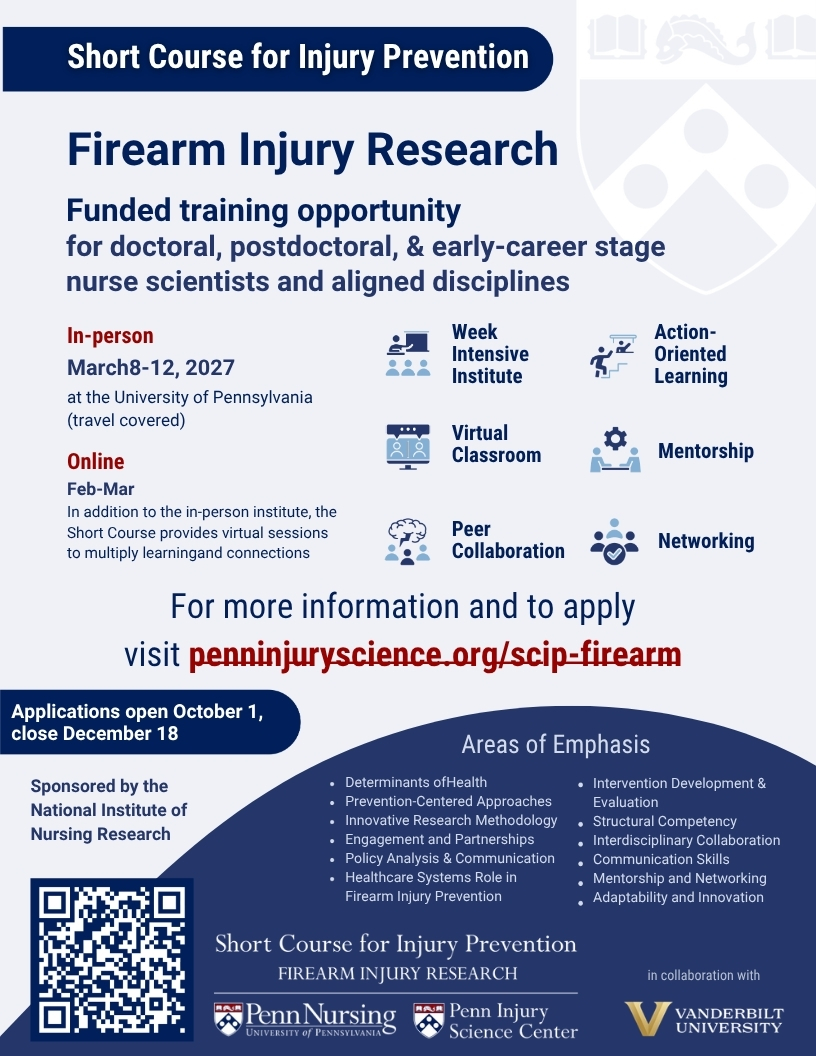
Apply for the R25 Short Course for Injury Prevention: Firearm Injury Research.
This funded training opportunity is hosted by the University of Pennsylvania and sponsored by the National Institute of Nursing Research.
The program combines a week-long, in-person Institute from March 8–12, 2027, with virtual pre- and post-course learning.
What the program offers
- Workshops, mentoring, and networking
- Action-oriented, community-centered research training
- Collaboration with a national network of nurse scientists and allied researchers
- Group and one-on-one mentorship from leaders in the field
Who should apply
Doctoral students, postdoctoral researchers, and early-career researchers in nursing and related disciplines are encouraged to apply. Relevant fields include medicine, public health, sociology, psychology, criminology, and urban planning.
Applicants should demonstrate a commitment to firearm injury prevention.
How to prepare your application
Applicants will be asked to submit a resume, curriculum vitae, or NIH biosketch and respond to two essay prompts. Each response must be 500 words or fewer.
- Motivation and career goals: What motivates you to apply for this course at this point in your career? Describe why firearm injury prevention research matters to you and how you see this training advancing your professional path.
- Community and interdisciplinary engagement: Firearm injury prevention often requires collaboration across communities, populations, and disciplines. Share how you have engaged with groups or stakeholders in your past work, and describe the additional communities, perspectives, or collaborations you hope to develop through your research.
Spots are limited, and participation is fully funded. Learn more and apply through the course website.
Learn more and apply
“The course was incredibly enriching; not only did I learn from outstanding presenters, but I also gained valuable insights into a wide range of projects addressing firearm injury prevention. What stood out most, however, were the relationships I built with fellow scholars and faculty. The collaborative and welcoming environment made this one of the most rewarding academic experiences I’ve had.”
—Participant, 2025–26 cohort